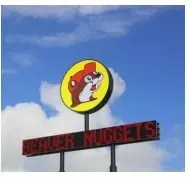
A roundup of some developments in the copyright world. The Copyright Claims Board issues its first attorney fee award. The Bartz v. Anthropic generative-AI class action settlement is approved. Generative-AI companies have been adding copyright guardrails to their products. Information about a website that is tracking AI lawsuits, and the latest Buc-ee’s trademark lawsuit.
PerfectPinz LLC (“PerfectPinz”) sells golf paraphernalia. It created four cartoon images depicting scenes from the Adam Sandler movie, Happy Gilmore.
One of the images is a cartoon image of the Happy Gilmore character on the ground, yelling at a golf ball to get in the cup (“Go home, ball!”) Another cartoon image of Mr. Gilmore is captioned “Just Tap It In.” A third one is a cartoonized version of the scene in the movie in which he brawls with Bob Barker. It is captioned, “The Price Is Wrong.” The last image depicts the Gilmore and Chubbs characters and is captioned “It’s All in the Hips.”
K9 King also produced golf paraphernalia based on these same scenes from Happy Gilmore.
Apparently, neither party secured permission from Universal Pictures to copy or make derivative works based on the movie.
PerfectPinz LLC filed a copyright infringement claim against K9 King, LLC in the Copyright Claims Board (CCB). The Board denied the claim.
To prevail on a copyright infringement claim, a plaintiff must prove (1) ownership of a valid copyright; and (2) unauthorized exercise of one of the exclusive rights of copyright ownership, such as the right to make copies of the original elements of the work. The Board rested its decision on the second requirement, ruling that PerfectPinz had not established that K9 King copied enough elements of the works that were original to PerfectPinz to qualify as infringement.
Images for comparison, from the complaint filed with the CCB
Because the copied elements were copies of scenes from the movie, they were not original to PerfectPrinz. Therefore, the Board ruled that K9 King had not copied any content original to PerfectPinz’s images.
Sanctions
The Board found that PerfectPinz acted in bad faith in failing to mention that the scenes it depicted in its images were copies of scenes in Happy Gilmore. This was not mentioned in the copyright registrations, either. This omission, the Board held, warranted an award of attorney fees to K9 King, in the amount of $900.
This is the first time the CCB has awarded attorney fees in a case. It is also one of those very rare times when a company that has made an unauthorized derivative work sues another company for also making an unauthorized derivative of the same work.
As I described in a 2025 blog post (“Ai OK; Piracy Not: Bartz v. Anthropic“), a federal district court in California last year determined that Anthropic is liable for copyright infringement in connection with its unauthorized copying of copyright-protected works to use in training its generative AI. Since then, the parties have entered into a settlement.
On July 20, 2026, the court issued an Order approving the settlement and awarding attorney fees. The settlement fund consists of $1.5 billion plus interest. $101,561,111 of it will go to the attorneys and several million dollars will be applied toward reimbursement of costs and expenses incurred and to be incurred in the future.
Copyright Infringement Guardrails
While this is not news about a court case, it is about a response to copyright infringement litigation.
As I explained in Generative AI: The Top 12 Lawsuits, OpenAI has been sued more than once for copyright infringement in connection with the training of its generative AI product, ChatGPT.
In Tremblay v. OpenAI, Inc., authors alleged that ChatGPT was trained on the text of books they and other proposed class members authored, without their permission, and that it facilitates output copyright infringement. The Judicial Panel on Multidistrict Litigation centralized dozens of AI copyright lawsuits against OpenAI into a single venue: U.S. District Court for the Southern District of New York. In Re OpenAI, Inc. Copyright Infringement Litigation. Tremblay is included in this consolidation.
Silverman et al. v. OpenAI is another such lawsuit. Sarah Silverman (comedian/actress/writer) and others alleged that OpenAI, by using copyright-protected works without permission to train ChatGPT, infringed copyrights. The case was subsequently consolidated into the Multidistrict Litigation (MDL) in the Southern District of New York.
Blocking users from reproducing large swaths of text from books or creating derivative works based on books used during training are “guardrails” against output infringement. According to Ars Technica, OpenAI’s ChatGPT is now refusing user requests to generate text that mimics the style of famous authors.
To test this, I prompted ChatGPT to “write something in the style of Tom James.” Here is the response I received:
As it happens, I am indeed the author of Tuber Tips, an offbeat compilation of whimsical and completely worthless suggestions of uses for sweet potatoes, along with some actual recipes. I had kind of hoped my name might bring to mind E-Commerce Law or IP Law for Non-IP Attorneys, but such is life.
The snippet it produced was completely bereft of humor. Everything in it was completely practical. The guardrails appear to be working.
AI Litigation Tracker
The website ExhibitAI.info is tracking “every lawsuit shaping the future of advanced AI.” The coverage spans 190 cases, 342 claims, 47 defendants, 117 plaintiff firms, and 44 courts.
The dataset reportedly is “updated continuously as new cases are filed and decided across jurisdictions.”
The dataset can be filtered by case type (copyright, tort, trademark, etc.), claims, date filed, defendants, forum, etc.
It looks like it could be a useful resource.
Buc-ee’s Redux
In a previous post (“Last Exit from Paradise“) I mentioned a trademark infringement lawsuit that Buc-ee’s, a popular chain of gas-and-convenience stores in the South. filed against Mickey’s gas stations. Well, now it has filed another one. This time, it is against Ohio-based Hanes Road Carryout, Inc.
Hanes Road Carryout, Inc. operates Beaver’s Mini Mart in Beavercreek, Ohio.. The complaint alleges that their logo is confusingly similar to Buc-ee’s because it “incorporate[s] a cartoon beaver with wide eyes and a smile” and “uses red as a predominant color in its exterior signage with its anthropomorphic representation of a cartoon beaver mascot.”
(Top: Buc-ee’s logo. Bottom: Beaver’s Mini Mart logo.)
What do you think, Beave?
Need help with a CCB case?
If you need help with a CCB case or other copyright matter, contact the Law Office of Tom James.
Artificial intelligence (“AI”) is generating more than content; it is generating lawsuits. Here is a brief chronology of what I believe are the most significant lawsuits that have been filed so far.
Artificial intelligence (“AI”) is generating more than content; it is generating lawsuits. Here is a brief chronology of what I believe are some of the most significant lawsuits that have been filed so far.
Most of these allege copyright infringement, but some make additional or other kinds of claims, such as trademark, privacy or publicity right violations, defamation, unfair competition, and breach of contract, among others. So far, the suits primarily target the developers and purveyors of generative AI chatbots and similar technology. They focus more on what I call “input infringement” than on “output infringement.” That is to say, they allege that copyright infringement is involved in the way particular AI tools are trained.
Thomson Reuters Enterprise Centre GmbH et al. v. ROSS Intelligence, Inc.
Thomson Reuters alleges that ROSS Intelligence copied its Westlaw database without permission and used it to train a competing AI-driven legal research platform. In defense, ROSS has asserted that it only copied ideas and facts from the Westlaw database of legal research materials. (Facts and ideas are not protected by copyright.) ROSS also argues that its use of content in the Westlaw database is fair use.
One difference between this case and subsequent generative-AI copyright infringement cases is that the defendant in this case is alleged to have induced a third party with a Westlaw license to obtain allegedly proprietary content for the defendant after the defendant had been denied a license of its own. Other cases involve generative AI technologies that operate by scraping publicly available content.
Update: The court has now issued a fair use decision in Thomson Reuters v. ROSS Intelligence. After reviewing the headnotes and comparing them with the database materials, Judge Bilbas concluded that 2,243 headnotes were sufficiently creative and original to receive copyright protection, that Ross infringed them, and that “fair use” was not a defense in this instance because the purpose of the use was commercial and it competed in the same market. This decision might have limited value as a precedent, since it involved non-generative AI. Generative AI tools may be distinguishable in the fair use analysis. The district court approved Ross’s motion for interlocutory appeal. The case is under review by the Third Circuit Court of Appeals.
This is a class action lawsuit against GitHub, Microsoft, and OpenAI that was filed in November, 2022. It involves GitHub’s CoPilot, an AI-powered tool that suggests lines of programming code based on what a programmer has written. The complaint alleges that Copilot copies code from publicly available software repositories without complying with the terms of applicable open-source licenses. The complaint also alleges removal of copyright management information in violation of 17 U.S.C. § 1202, unfair competition, and other tort claims.
Updates: The court dismissed most of the plaintiffs’ claims, but allowed them to proceed with claims for breach of open-source licenses and granted leave to amend the DMCA claims in the complaint.
Plaintiffs filed an amended complaint. The court, however, dismissed the DMCA claim, reasoning that the statute imposes an “identicality” standard (i.e., the AI’s output must be an exact, literal copy of the plaintiff’s work). Because plaintiffs alleged that Copilot’s outputs often generate modified versions of their original code rather than strict identical copies, the court dismissed the claim.
Judge Tigar certified the question whether identicality is required for interlocutory appeal to the Ninth Circuit Court of Appeals
Update: As noted in my first update on Anderson v. Stability, Judge Orrick dismissed all claims except for Andersen’s direct infringement claim against Stability. Most of the dismissals, however, were granted with leave to amend.
Trial is scheduled for 2027.
Getty Images v. Stability AI
Plaintiffs filed an amended complaint, having secured proper copyright registrations for the underlying art. Defendants filed a motion to dismiss it. The court denied the motion. The ruling on the motion suggests that copied images scraped into the training datasets can constitute direct infringement, and that AI models may inherently constitute a continuous, new form of infringing materials. The court also allowed the artists’ claims regarding false endorsement and trade-dress infringement to proceed. These claims address AI tools mimicking an artist’s name and style.
Getty Images has filed two lawsuits against Stability AI, one in the United Kingdom and one in the United States, each alleging both input and output copyright infringement. Getty Images owns the rights to millions of images. It is in the business of licensing rights to use copies of the images to others. The lawsuit also accuses Stability AI of falsifying, removing or altering copyright management information, trademark infringement, trademark dilution, unfair competition, and deceptive trade practices.
Stability AI has moved to dismiss the complaint filed in the U.S. for lack of jurisdiction.
Updates: Getty voluntarily dismissed the Delaware case and refiled the lawsuit in the U.S. District Court for the Northern District of California. Getty Images v. Stability AI, No. 3:25-cv-06891 (N.D. Calif. 2025).
In 2026, Judge Thompson dismissed the DMCA claim, but allowed claims for direct copyright infringement, trademark violation, and unfair competition to proceed.
Getty Images dropped the input-infringement copyright claim that it had filed in the U.K., primarily because it could not definitively prove where the model was trained (i.e., whether it was inside or outside the UK).
The UK court rejected Getty Images’s argument that the Stable Diffusion software itself was an “infringing copy” of an article imported into the UK. The court ruled that AI model weights are not copies; they are abstract statistical parameters that do not store or reproduce actual images.
Getty Images prevailed on trademark claims in the U.K., however.
Jack Flora and others filed a class action lawsuit against Prisma Labs for invasion of privacy. The complaint alleges, among other things, that the defendant’s Lensa app generates sexualized images from images of fully-clothed people, and that the company failed to notify users about the biometric data it collects and how it will be stored and/or destroyed, in violation of Illinois’s data privacy laws.
Update: The court granted a motion to compel arbitration.
This is a publicity rights case. NeoCortext’s Reface app allows users to paste images of their own faces over those of celebrities in photographs and videos. Kyland Young, a former cast member of the Big Brother reality television show, has sued NeoCortext for allegedly violating his publicity rights. The complaint alleges that NeoCortext has “commercially exploit[ed] his and thousands of other actors, musicians, athletes, celebrities, and other well-known individuals’ names, voices, photographs, or likenesses to sell paid subscriptions to its smartphone application, Reface, without their permission.”
NeoCortext has asserted a First Amendment defense, among others.
Update: U.S. District Judge Wesley L. Hsu denied NeoCortext’s motion to dismiss. Judge Hsu ruled that Young’s right of publicity claim was not preempted by the Copyright Act because he was seeking to vindicate the misuse of his personal likeness, not just the distribution of copyrighted images. The app’s face-swapping capabilities did not qualify as a “transformative use” defense as a matter of law at the dismissal stage.
Walters v. OpenAI, LLC
Walters v. OpenAI, LLC, No. 2023-cv-03122 (N.D. Ga. July 14, 2023) (Complaint originally filed in Gwinnett County, Georgia Superior Court on June 5, 2023; subsequently removed to federal court)
This is a defamation action against OpenAI, the company responsible for ChatGPT. The lawsuit was brought by Mark Walters. He alleges that ChatGPT provided false and defamatory misinformation about him to journalist Fred Riehl in connection with a federal civil rights lawsuit against Washington Attorney General Bob Ferguson and members of his staff. ChatGPT allegedly stated that the lawsuit was one for fraud and embezzlement on the part of Mr. Walters. The complaint alleges that Mr. Walters was “neither a plaintiff nor a defendant in the lawsuit,” and “every statement of fact” pertaining to him in the summary of the federal lawsuit that ChatGPT prepared is false. A New York court recently addressed the questions of sanctions for attorneys who submit briefs containing citations to non-existent “precedents” that were entirely made up by ChatGPT. This is the first case to address tort liability for ChatGPT’s notorious creation of “hallucinatory facts.”
In July, 2023, Jeffery Battle filed a complaint against Microsoft in Maryland alleging that he, too, has been defamed as a result of AI-generated “hallucinatory facts.” Battle v. Microsoft.
Update on Walters v. OpenAI, LLC: In 2025, the court granted summary judgment in favor of OpenAI, on three grounds:
No Factual Statement: The court ruled that a reasonable reader would not interpret the ChatGPT output as stating actual facts. This was heavily influenced by the AI’s internal disclaimers, its warning to the user that it lacked access to the referenced document, and the user’s own admission that he quickly verified the claim was false.
No Fault or Malice: To win a defamation claim as a public figure, Walters needed to prove OpenAI acted with negligent disregard for truth or “actual malice.” The court found he failed to provide evidence of either. OpenAI successfully argued that it leads the AI industry in reducing such “hallucinations” through training and human feedback.
Lack of Damages: The court noted Walters did not suffer provable damages or ask OpenAI for a retraction before filing, making him ineligible to recover the punitive or presumed damages he sought.
This lawsuit has been brought by underage individuals against OpenAI and Microsoft. The complaint alleges the defendants’ generative-AI products ChatGPT, Dall-E and Vall-E collect private and personally identifiable information from children without their knowledge or informed consent. The complaint sets out claims for alleged violations of the Electronic Communications Privacy Act; the Computer Fraud and Abuse Act; California’s Invasion of Privacy Act and unfair competition law; Illinois’s Biometric Information Privacy Act, Consumer Fraud and Deceptive Business Practices Act, and Consumer Fraud and Deceptive Business Practices Act; New York General Business Law § 349 (deceptive trade practices); and negligence, invasion of privacy, conversion, unjust enrichment, and breach of duty to warn.
Another copyright infringement lawsuit against OpenAI relating to its ChatGPT tool. In this one, authors allege that ChatGPT is trained on the text of books they and other proposed class members authored, and facilitates output copyright infringement. The complaint sets forth claims of copyright infringement, DMCA violations, and unfair competition.
Updates: The court dismissed claims of vicarious copyright infringement, Digital Millennium Copyright Act (DMCA) violations, negligence, and unjust enrichment. Claims for direct copyright infringement of the input kind, and unfair trade practices, survived.
Sarah Silverman (comedian/actress/writer) and others allege that OpenAI, by using copyright-protected works without permission to train ChatGPT, committed direct and vicarious copyright infringement, violated section 17 U.S.C. 1202(b), and their rights under unfair competition, negligence, and unjust enrichment law.
Updates: In February 2024, U.S. District Judge Araceli Martínez-Olguín issued a joint ruling covering both the Tremblay and Silverman motions to dismiss. The court dismissed claims of vicarious copyright infringement, negligence, and unjust enrichment, but allowed the input infringement claim to proceed. OpenAI did not contest that using the plaintiffs’ books to train its Large Language Models (LLMs) required a “fair use” determination
On June 25, 2025 Judge Chhabria issued a ruling on fair use. The court granted Meta’s motion for summary judgment on fair use with respect to AI training; reserved the motion for summary judgment on the DMCA claims for decision in a separate order, and held that the claim of infringing distribution via leeching or seeding “will remain a live issue in the case.”
The case has been consolidated into the broader Multidistrict Litigation (MDL) pending in the Southern District of New York.
This is a lawsuit against Google and its owner Alphabet, Inc. for allegedly scraping and harvesting private and personal user information, copyright-protected works, and emails, without notice or consent. The complaint alleges claims for invasion of privacy, unfair competition, negligence, copyright infringement, and other causes of action.
Update: Plaintiffs voluntarily dismissed defendants Alphabet Inc. and Google DeepMind. Google LLC remains the sole defendant, and the litigation—now tracked as In re Google Generative AI Copyright Litigation—is proceeding.
On the regulatory front
The U.S. Copyright Office is examining the problems associated with registering copyrights in works that rely, in whole or in part, on artificial intelligence. The U.S. Federal Trade Commission (FTC) has suggested that generative-AI implicates “competition concerns.”. Lawmakers in the United States and the European Union are considering legislation to regulate AI in various ways.
Update on Copyright Office Reports: The Copyright Office has issued reports in three parts:
Part 1: Digital Replicas
Released on July 31, 2024, this initial part addresses the unauthorized use of AI to realistically replicate an individual’s voice or appearance (e.g., deepfakes and AI-generated music tracks mimicking famous artists). The Copyright Office recommends that Congress enact a new federal law to protect individuals from unauthorized digital replica distributions. SeeCopyright and Artificial Intelligence Part 1 -Digital Replicas.
Part 2: Copyrightability
This Report addresses whether and to what extent AI-generated output is protected by copyright. Key findings and conclusions:
Prompts are Insufficient: Text prompts generally function merely as instructions to convey unprotectable ideas. Because a user does not exercise ultimate creative control over how the AI generates the final material, prompts alone do not establish human authorship.
AI as a Creative Tool: If a human author maintains sufficient control over the expressive elements, the work can be protected. For example, if a creator inputs their own hand-drawn art and uses AI to refine it, the original perceptible human work remains copyrightable.
Modifications and Arrangements: Humans can claim copyright over the creative selection, coordination, arrangement, or expressive modification of AI-generated content. However, protection only applies to the human-contributed elements, not the AI-generated parts. The Copyright Office mandates transparency. Authors submitting registration applications have a duty to disclose and disclaim any AI-generated content within their applications that is more than minor (de minimis)
No New Laws Needed: The Office concluded that existing legal frameworks are flexible enough to evaluate AI cases on a case-by-case basis without need for new legislation.
This report deals with copyright issues associated with the use of copyrighted works in generative-AI training, especially input infringement.
Fair Use Limitations: Using commercial troves of copyrighted works to build models that directly compete with original authors likely stretches past fair use boundaries.
The Role of Licensing: The Office highlighted that voluntary licensing markets are already actively emerging across the music and news sectors.
As I mentioned in my last blog post, the USPTO’s new online Trademark Center now includes a feature that makes it much easier to conduct a trademark image search. This means that instead of scouring the Trademark Design Search Code Manualto try to identify the design attributes that a logo or proposed design possesses, you can ask the new AI-powered search system to look for marks that are similar to an image that you upload. In this article, I will describe the step-by-step process for conducting a trademark image search of the USPTO’s database.
Step-by-Step Guide to USPTO Image Search
Time needed: 10 minutes
An illustrated step-by-step guide to searching with the USPTO’s new Trademark Image Search tool
Log in to your USPTO account.
You can access the Trademark Image Search tool only when you are logged in to a USPTO account. Visit uspto.gov and click the tab at the top of the screen. You will be offered three options: Log in with your USPTO.gov account, Create a USPTO.gov account, Reactivate my USPTO.gov account. Make the appropriate selection for your situation.
Navigate to the Search Trademarks page
Open the Trademarks tab at the top of the screen. Then click on the Search trademarks link. This will load the primary search bar page. The dropdown menu on the left defaults to Wordmarks but you will change this in the next steps.
(Optional) Initiate a design code search.
You can skip this step if you are only interested in using the USPTO’s new Image Search tool. The USPTO recommends using both the new tool and the old design code method. To search for an image the old-fashioned way, select Design code from the dropdown menu on the left end of the search bar. Then type your search code into the text box. Alternatively, you can opt to search by field tags. To do that, select Field Tags and Search builder from the dropdown menu. When you select this option, you can search for design codes using the DC field tag. Searching with field tags has the advantage of enabling you to build a search string specifying more than one parameter.
(Optional) Find the right design code(s).
Design codes are listed in the USPTO’s Trademark Search Design Code Manual. Each one consists of a series of numbers. Top-level categories are represented by the first couple of numbers. The numbers to the right represent increasingly specific subcategories. It can take a while to find the appropriate design code(s) for a logo you wish to search.
Select Image Search from the dropdown menu.
To access the new Image Search tool, select Image search from the dropdown menu on the left side of the search bar.
Click the camera icon.
A small image of a camera is located on the right end of the search bar. Click it. A pop-up window inviting you to upload your image will appear.
Upload the image.
You can upload your image three ways. (1) Drag and drop it into the box; (2) Click Browse files to select a local drive file; (3) Paste a direct image URL into the box. Ensure your file is a JPEG, PNG, GIF, or TIFF under 2 MB, then click Next.
Ensure Image Search is selected.
The search bar should now display a thumbnail image of the logo you uploaded. The dropdown menu should have Image search selected.
Correct the dropdown selection, if needed.
If the dropdown menu is displaying Wordmark or anything else, change it to Image search. You should now have a screen displaying a thumbnail of your image, Image search selected in the dropdown menu, and small camera and magnifying glass icons at the right end of the search bar.
Click the Search icon.
Click on the magnifying glass icon to execute the image search. A screen displaying one or more trademark records matching your query should appear. The illustrative trademark image search I conducted using the Nike logo turned up several matches. You can filter these using the controls in the left sidebar. For example, you could limit results to “live” registrations and applications, if you wish. You can also restrict the results to specific classes of goods and services. You can sort the results in various ways, such as by relevance, alphabetically, etc.
Click a record for more details.
To learn more about a record that turned up in your search results, click on it. That will take you to a page with a lot of information about it. You’ll find an image of the mark, the serial and/or registration number, as applicable, the class(es) of goods or services, and other kinds of information.
Scroll for more information.
If you scroll down the webpage for a record, you will find a huge amount of information about the trademark and its owner.
Review prosecution history
You can find information about the trademark’s prosecution history and relevant documents.
Toggle to TSDR.
The Trademark Center enables you to toggle from the trademark image search results to TSDR, the Trademark Status and Document Retrieval entries for a record. In TSDR, you can select three different tabs: (1) Status; (2) Documents; (3) Maintenance. The Status tab provides much of the same information you can find by clicking on a record in the Search results page. The Documents and Maintenance tabs provide access to much more information.
Access documents.
The Documents tab in TSDR gives you access to the documents that have been filed in connection with the trademark application or registration you are reviewing. These include things like specimens of use, registration certificates, office actions and responses, and others. The Maintenance tab provides information about renewals and such.
Review filings.
You can access a document listed in the Documents tab by clicking on the hypertext link for it. This enables you to review the specimen of use that was submitted in support of an application for registration of a particular trademark, for example.
Limitations
The Trademark Center’s new trademark image search functionality will be a major timesaver in those cases where the image you are searching matches one that is in the USPTO’s database of trademark registrations and applications. When I searched with the familiar Nike logo and sorted results by relevance, for example, a number of exact matches turned up, and I gained almost immediate access to a wealth of information about it. The new Image Search should be very useful for conducting knock-out searches in those situations where a proposed logo happens to match an existing one.
Its capabilities are a bit more limited, however, when it comes to advanced trademark searches for potentially similar images. I tested it by uploading a random picture of a mosquito.
These are the first few of at least a thousand results this image search turned up:
This was even after filtering out “dead” results, limiting the search to IC 005, and sorting the results by relevance.
Being a Minnesotan, I can sort of understand the relevance of the ones with airplanes in them. Both airplanes and mosquitoes fly, after all. And mosquitoes can indeed be big here. The likelihood that consumers would confuse any of these logos with a mosquito, however, seems to me to be about as close to zero as it is possible to get.
Currently, “Field tags and Search builder” is a single selection in the dropdown menu, and there isn’t a field tag that represents the results of an image search. This means that when you are using field tags, it is still necessary to rely on traditional design search codes. It would be a major upgrade if the USPTO allowed users to combine Image Search and Field Tag searching together, allowing you to constrain visual AI results by the strict specifications set out in field tags.
Nevertheless, I am still enthusiastic about the Trademark Center’s new AI-assisted image analysis functionality. I am sure it will also be very useful in terms of drafting acceptable descriptions of logos to include in applications.